How Kakuma Digital Network Will Empower Refugees and Host Communities
In Kakuma, opportunity has always existed
How Kakuma Digital Network Will Empower Refugees and Host Communities in Kakuma—Especially the Most Marginalised
In Kakuma, opportunity has always existed. What has been missing is access.
For more than 200,000 refugees and tens of thousands of host community members in Turkana County, daily life is full of skill, resilience and enterprise — tailors, teachers, barbers, boda riders, shopkeepers, students with top exam marks and mothers running table-top businesses before sunrise. What is scarce is not talent. It is affordable connectivity to let that talent reach beyond the camp’s dusty roads.
Kakuma Digital Network (KDN) was founded in Kakuma by people who live and work here to change that. We are not yet an operational internet provider — we are in the development and establishment phase — but our purpose is clear: to build community-centred connectivity that empowers the most marginalised first, not last.
This is how.
1. We put refugees and host communities on the same network — by design.
Many projects serve one side and forget the other. That creates tension. KDN serves both.
Our planned coverage zones — Kakuma 1, 2, 3, 4, Kalobeyei and the surrounding host community — were drawn from where people actually live, trade and go to school together. When you register interest on kdn.org, we ask for your zone, not your status. A household in Kakuma 1 and a household in the host community count the same.
Our proposed impact targets say it plainly: 2,000 people reached, 200 household connections, 50 small businesses, 10 schools and institutions, 10 public hotspots, and 300 people trained — together, as one community. Those are proposed 12-month targets, not results. We publish them now so you can hold us to them later.
Empowerment here means no one is asked to prove vulnerability to get online. You are a neighbour, and neighbours share the same network.
2. Education before entertainment — connectivity that pays for itself in learning
Data is expensive in Kakuma. When a family spends KES 200 on bundles, the choice is often between a child watching a lesson and calling a relative. That is a cruel choice.
KDN’s residential packages are being designed for learning first: proposed home Wi-Fi from KES 999/month, family concepts at KES 1,499/month, and community Wi-Fi day passes from KES 50—all proposed, to be confirmed after technical and licensing readiness. Even before a single cable is laid, our Digital Inclusion programme is being built around what students actually need:
- Digital literacy in Kiswahili, English and Somali — starting with how to search, verify and stay safe
- Computer basics for primary and secondary learners who have never touched a laptop
- Online safety, especially for girls, so parents trust the connection enough to let daughters use it
- Digital entrepreneurship — how a Form 4 leaver can earn without leaving Kakuma
Our transparency tracker on the homepage will show 0 / 2,000 reached today. That honesty matters. When the first 200 households come online, you will see 200 / 2,000. Not a donor report — a public promise.
3. Small business first — because enterprise is already here
Walk through the Kakuma 3 market at 9am. Every second stall is already a business without internet: printing, tailoring, phone charging, beauty, electronics, and bulk maize. What they lack is not grit. It is payments, markets and customers beyond foot traffic.
KDN Marketplace — already open for registration at /marketplace — is our first economic empowerment tool, before the network is even live:
- Free to register, free to list, no commission — KDN never takes a cut
- Every business is reviewed by a real person (not auto-published).
- KDN Verified badge after documents are checked (verification is not a guarantee, but it means someone checked)
- Each listing now has an offline QR pass + WhatsApp catalogue: print the QR as a shop sticker. A customer with a feature phone scans, sees your offerings, and orders on WhatsApp — even without data for Google search. That is instant digital inclusion for a mama mboga whose customers don’t type URLs.
When connectivity arrives, that same QR becomes an order button. Until then, it is a bridge.
4. Women, youth and persons with disabilities — not as an afterthought, but as the core
In Kakuma, women run households, and host-community women run farms that feed those households. Youth make up 60%+ of the camp. Persons with disabilities face double exclusion: stigma plus no access.
KDN refuses to build a network they can’t use. Concretely:
- Training cohorts will prioritise women-led households — we track “people receiving digital skills training” separately because if women aren’t in the room, inclusion has failed.
- Online safety is not a footnote; it is module one. A mother must know her daughter is safer with KDN than with a random cyber café clerk holding her password.
- Locations for future public hotspots are being assessed for safety, lighting and distance — a hotspot 400 m away through an unlit path is not accessible for a 16-year-old girl.
- For persons with disabilities, we partner with Turkana-based inclusion specialists to design accessible learning spaces, not to tick a box.
Empowerment is not “we connected her". It is “she now runs her WhatsApp catalogue and teaches her neighbour.”
5. Host community means shared growth, not charity.
The host community around Kakuma has hosted refugees for over 30 years, often with less global attention. KDN’s model explicitly includes host community zones and businesses from day one — same prices, same QR, same queue for community Wi-Fi.
When a Turkana youth in the host community repairs solar backups for hotspot sites, that is not corporate social responsibility. That is local capacity. When a host farmer lists tomatoes on the Marketplace alongside a refugee tailor, customers see one Kakuma economy, not two camps.
That is why our founder is based in Kakuma, not Nairobi. Stewardship matters more than strategy decks.
What we will not do
To empower you honestly, we must be clear about limits:
- We are NOT yet an operational or licensed provider. No one should pay for service today. Registration is interest-only.
- We do NOT collect online donations. Funding discussions happen via partnership enquiries with written scope and invoices where appropriate.
- We do NOT sell your data or show fake testimonials. Every cost on /costs is “Figure not published yet” until a supplier verifies it. We would rather show a blank than a lie.
- Verification is not endorsement. A blue badge means we checked documents — not that we guarantee quality.
That honesty is itself empowerment: you can say no with full information.
How you can be part of this — today, while we build
You don’t have to wait for fibre to act:
1. Register interest — 2 minutes at /coverage (choose your zone) or /residential-internet. Your click tells us where to survey first. Demand decides deployment. 2. List your business — Free at /marketplace. Get your QR pass and stick it on your shop tomorrow. 3. Partner technically or financially — Infrastructure, backhaul, solar, training, or grant funding via partners. We publish the funding pipeline transparently on the homepage once verified. 4. Keep us honest — Read our transparency and accountability page at /legal/transparency-and-accountability. If we drift from community-centred to donor-centred, call it out.
---
KDN’s promise is simple: an Internet that belongs to Kakuma, not just arrives in Kakuma.
We will measure empowerment not by megabytes, but by whether a refugee mother in Kakuma 2 and a host mother in the surrounding village both tell the same story: “My child learned, my business grew, and no one asked me to leave my community to get online.”
That day is not today. It is what we are building toward — transparently, together.
Development phase notice: All packages, coverage and launch dates are proposed planning figures. No service is currently sold at these prices, and availability will be confirmed after technical, regulatory and financial readiness checks.
— Olivier Hoga, Founder & Project Lead, Kakuma Digital Network — Kakuma, Turkana County, Kenya
Contact: info@kakumadigitalnetwork.co.ke | +254 795 587 773 | www.kakumadigitalnetwork.co.ke
--- Tags for News CMS: community connectivity, digital inclusion, refugee empowerment, host community, Kakuma, Turkana, women and youth, Marketplace QR, development phase
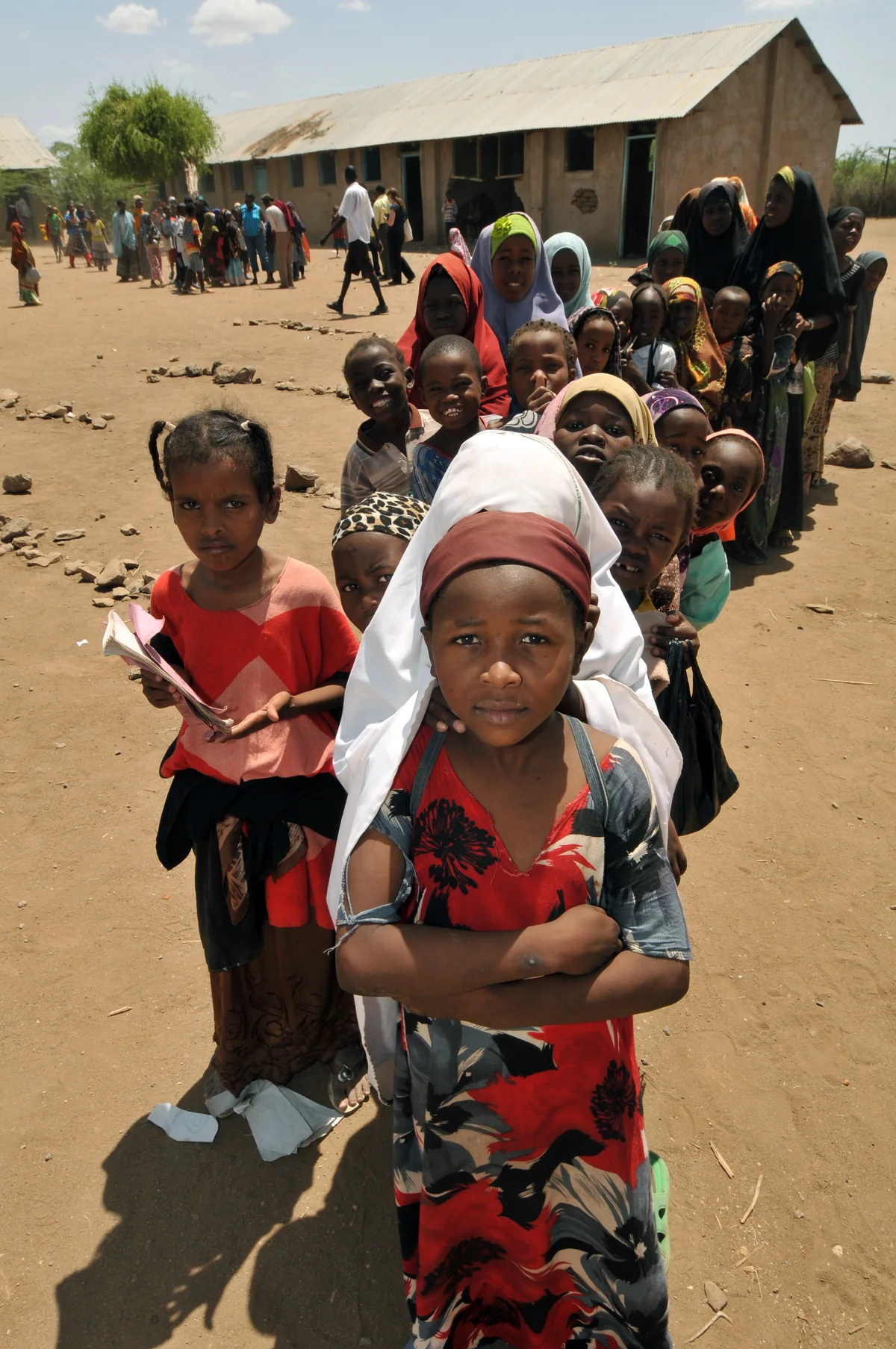
Featured image alt (use for accessibility): School children in Kakuma refugee camp, Kenya, 2011. Photo by D. Willetts / UNESCO GMR, CC BY-SA 3.0 IGO — illustrating community context, not KDN operations.
Stay connected with KDN
Subscribe for verified project updates and opportunities.
Newsletter subscription